Showing posts with label fantasy. Show all posts

Friday, March 4, 2016

The Ocean at the End of the Lane | by: Neil Gaiman

So, you might have heard of Neil Gaiman. Dude's done pretty well for himself as a writer; basically everyone has heard he's great. Unfortunately, I have not read any of his books since Coraline when I was twelve despite the fact that I really enjoyed it. But when I had to read a couple of his short stories for a class about two years ago and The Ocean at the End of the Lane was released, I became quite curious. I had a feeling that it would be a good book.

Even though this is technically an adult book with an adult-aged protagonist, as the narrator returns to the lane he grew up on, he relives memories from his childhood, and those memories take precedence in this small novel. He returns to his neighbors, the Hempstocks and their farm, where he experienced mind-boggling, near-death experiences with his friend Lettie, who protected him from the monsters of other dimensions as they entered the world as us ordinary people know it. Memories fade with time, and some are simply unreliable, but going back to the place where such beautiful and horrible things occurred makes it all come back to the narrator.

To be honest, in the first half of this book I was a little unsure of how I felt about it. Even though the writing impressed me right off the bat and the general uniqueness of the monsters intrigued me, I felt it might be a little too far in left field for me to truly love. After all, some of these monsters are hard to fathom. I mean... A canvas? Really? And Ursula is the kind of antagonist bound to make readers' skin crawl. She bugged me. But I rolled with it all and was determined to give it a fair chance. It all had to be leading up to something, but I couldn't quite tell what it could be. 

I think the last 25% of the book is when I realized that I was completely in love with it despite any initial thoughts, because it certainly did lead up to something, and my God was it beautiful. I wasn't expecting something that seemed so creepy and quirky to end up being so gorgeous. If these are the types of feeling all of Gaiman's work leaves people with, then I need to buy the rest of his books ASAP. I can't stop thinking about it. The Hempstocks are so intriguing, as are the revelations our narrator had as a child. Childhood is important to our understanding of the world, even if we can't make sense of what we see.

The Ocean at the End of the Lane is full of imagination and beautiful passages that I just want to reread forever.

Wednesday, January 6, 2016

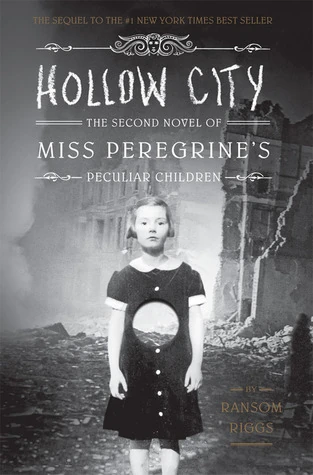
Hollow City | by: Ransom Riggs

*This review will likely contain spoilers for those who have not read Miss Peregrine's Home for Peculiar Children.

Hollow City is the second installment in Ransom Riggs' Miss Peregrine's Peculiar Children trilogy, which fuses strange vintage photographs into the reading experience. Jacob and his peculiar new friends are on an urgent and dangerous mission: They must find a way to help Miss Peregrine return to her human form, and quickly - but that isn't the easiest things to do in 1940s Britain. The Nazi army keeps dropping bombs as monstrous hollow and wights chase after the children. As they move along their journey, they have to make decisions concerning their ethical standards, and ultimately, what they are willing to fight for.

Despite the fact that Miss Peregrine's Home for Peculiar Children really impressed me when I read it years ago as well as when I reread it earlier this year,  Hollow City wasn't as easy to appreciate. I read the beginning and ending rather quickly, but the middle took a while for a few different reasons. To be completely honest... I guess I just didn't expect this entire book to deal with trying to save Miss Peregrine. I guess I thought that would take one third of the book and then the plot would get bigger. So there's one issue. And I will freely admit that by the time I reached the halfway mark I was at an exciting time in my personal life that made this novel seem a little dull by comparison (and I think this is the first time in my whole life I can say this lovely phenomena has happened). But perhaps the most prevailing issue is that despite the singular plot goal, I just didn't feel like all the obstacles the children faced truly tied together. It felt less like plotting and more like 'let's put in obstacles to make the book longer' at times. Placing so many moments where Jacob reflects on how everything is so crazy compared to his old life also gave me this vibe.

However, I did not dislike the book overall - my feelings are generally mixed. It certainly had some good qualities. Once again I appreciated the use of old photographs to enhance the story and the fact that it takes place in the dark WWII-era Britain, and even though Jacob and Emma's romance was underplayed in many respects, I liked that Riggs kept it innocent and fluffy. Plus, I think all the abilities are really cool - especially the ones that Emma, Althea, and Olive have. Even aside from their peculiar abilities, some of the characters warm my heart... Olive is just the sweetest thing and I love how motherly Bronwyn is with her friends!

But what truly made me like this book better by the time I reached the end are the twists. A few things are either discovered or occur that I never saw coming - I gasped at a couple moments. And the cliffhanger! It was a bit of a frustrating place to leave us hanging, but I thing Riggs built a solid foundation for the trilogy's conclusion, Library of Souls, which just came out this year. I anticipate that it will be the most action-packed of the series if this is going where I think it's going.

Hollow City, in short, has some prominent good points and prominent not-so-good points. I wish I could have liked it as much as the first installment of Miss Peregrine's Peculiar Children, but I'm hopeful for the next book, Library of Souls.

Wednesday, July 22, 2015

Throne of Glass | by: Sarah J. Maas

Throne of Glass seems to be one of the most-loved fantasy series in YA right now and I had definitely been feeling the hype. The last book I read with a ton of hype was Laini Taylor's Daughter of Smoke and Bone, and it didn't sit well with me overall, and I was afraid of Throne of Glass being a similar disappointment. Fortunately, it wasn't.
 
The premise itself is pretty deep. An assassin by the name of Celaena Sardothien has been enslaved by the Kingdom of Adarlan after finally being caught, and she has been kept in absolutely wretched conditions. But now she has the chance to win freedom through a competition, the only problem being that she would have to work for the King of Adarlan if she won, the very person responsible for all her traumas. As if that situation wasn't emotionally-compromising enough, it's becoming apparent that someone in the glass castle is using magic for brutal murder. Oh, and there's a love triangle.
 
So, there's a lot of drama to absorb in this one, but it's all quite epic. The idea of an Otherworld and the people and creatures who roam between dimensions reminds me a bit of Prophecy of the Sisters by Michelle Zink, but I think the magic has a lot more potential in this series. To be honest, I thought the mystery of who could possibly be causing the murders and for what purpose was relatively easy to figure out, but the lack of a major twist in that department doesn't make this book less intriguing. I found the characters far too interesting to ever be bored.
 
Our leading lady Celaena is different than what I generally expect from badass female protagonists. While she is undoubtedly tough and lets everyone know it (and possesses the skills to prove herself), she still has a feminine side that shines through. She may be able to kill even the most-skilled of those around her within minutes, but she still wants to wear dresses and attend balls. She still has a puppy. Her inability to remain confined to one stereotype is what I like most about her.

Even the love triangle flows better than in most novels. Chaol and Dorian are actually both contenders, much like Gale and Peeta in much of the Hunger Games books. Far too often, a second love interest is only thrown into the mix for the sole purpose of shaking things - he/she scarcely ever seems to be a real contender. But both Chaol and Dorian get plenty of time with Celaena and both are so different that it's easy to appreciate them individually. I'm honestly not very sure how this will end up working, but I certainly look forward to finding out.

Plus, it's obvious that Celaena is going to be part of something even bigger than she ever imagined, and I think the series will be even more epic because of it. Throne of Glass was a great series-starter - Sarah J. Maas definitely has me hooked - and I'm very optimistic about what the rest of the series will be like.

Monday, February 16, 2015

Daughter of Smoke and Bone | by: Laini Taylor

Daughter of Smoke and Bone is the first installment of Laini Taylor's beloved fantasy/paranormal trilogy which follows the story of a peculiar girl named Karou. Karou is a human, and she goes to school just like any other human girl would, but her home life is unlike any other. She has been raised by monsters in a shop. Brimstone, the only father figure she's ever had, always has her running errands collecting different types of teeth from all over the world and he's never told her why.
 
An errand trip gone awry in which Karou must fight for her life may seem to make her circumstance even more confusing, but it will lead her to the truth she's been deprived of her whole life.
 
I was incredibly excited to start this book. It seemed that everywhere I turned in the wide and wonderful world of the Internet there was always someone fangirling like crazy over this trilogy, and the more I heard about it, the more amazing it seemed. People said it was dark and complicated and just downright fabulous. Apparently I'm the odd one out because to be honest, it's hard for me to pinpoint my feelings about this book. I've never read something and felt such overwhelming uncertainty until now. The only fear I had is that it could be a little overhyped, and that's not even my problem. Bear with me.
 
At first I was quite intrigued. The setting is unique and the characterization is impressive - that goes for both the humans and the chimera. Since Karou doesn't even know that much about her mysterious world, it leaves a lot of room for a reader to wonder, and when there are characters collecting tons of teeth... Well, you know you're in for something interesting. My first reaction to the first 150ish pages was "This book is weird." And I meant that in a positive way. I was intrigued and entertained. Plus, Taylor's writing is pretty, and it's definitely darker than quite a bit of YA fantasy/paranormal in terms of both the writing and the overall plot.

So after this initially positive reaction, what swayed my opinion toward the negative side? Akiva came along. There's nothing wrong with him as a character or anything. In fact, I like him well enough. The romantic element is done well: Laini Taylor really makes sure her readers feel ALL the feelings and she does the whole reincarnated-love thing better than what I've seen in the past. That's all fantastic and whatnot, but I keep running into the same problem: There are simply too many parallels to Sonja and Lucian's story explained first in the 2003 film Underworld and then explored in depth in the 2009 film Underworld: Rise of the Lycans. Karou and Akiva's specific forbidden love felt unoriginal and so did the past execution - especially the past execution. This aspect of the story would've made Daughter of Smoke and Bone special, but I just can't love it like everyone else, not when I can't stop thinking "this has been done before." I suppose one could argue that the general set-up 'wasn't that original anyway' if he or she wanted, and that if one of the characters in the flashback was human I might not see make the connection as clearly, but this is the first time I've come across anything this similar and the similarities still manage to unsettle me.

Perhaps all the hype it got does contribute to my feelings after all. Maybe if I wasn't expecting something so complicated and new and out-of-this-world (well... it technically is out of this world, but you get the idea) I wouldn't judge it so harshly. Perhaps if I wasn't so in love with Sonja and Lucian's story I wouldn't feel so abrasive towards this book... But it is what it is: The similarities are just too much for me personally. I already have a copy of the second book, Days and Blood and Starlight (although I wish I didn't get it) and I'll have to give it a try eventually and see if I like it any better now that we know Karou's story and can move on.

I'm not feeling too positively about this trilogy so far, but maybe Taylor can change my mind with the second book.

Saturday, June 14, 2014

Crossing the Threshold | by: Amanda Dirlam and Melanie Overmyer

Crossing the Threshold is the first book of the Changeling trilogy, and it is the debut novel of Amanda Dirlam and Melanie Overmyer. They may be new to the bookish scene, but with a story like this, I think they’re going to fit right in.

Shea is a shy high school girl that hopes to get by without much attention. Her home life with her crazed, New Age-obsessed mother isn’t by any means ideal, so she oftentimes seeks refuge with her beloved grandparents or hangs out with her best friend Ty. But other than that, Shea doesn’t have much of any interaction with others due to her ability to withdraw from being anybody’s focus. However, Quinn is a popular football player that suffers from confusion concerning his identity, and even though they make an unlikely pair, the two of them have to complete a project together concerning Irish heritage. As they discover more and more about changelings and prepare for the project, they also discover that their past biases toward another need not apply any longer.

The truth is that they’re both part of something big. Something that concerns both of them is tying them together, but what will it take to get them to cross the threshold from our world into one that’s full of magic?

While this novel is technically a fantasy, it’s primarily set in the world as we know it with flashes of mysterious moments to unknown characters of a different realm. We don’t dive too deeply into the fantasy element, and because of that, it feels more like a contemporary at times. This is one of its best, most unique qualities; I love how it appeals to both genres and how nature is used to represent something more mystical. It will definitely capture fans of either genre’s attention.

Even so, this debut novel handles both genres in a different way. It’s not every day you run into Irish mythology, at least not in young adult fiction. That in itself adds an interesting new concept for readers. I’ve never read anything about Irish mythology, or changelings, and to be honest, I wasn’t even sure of what a changeling was before reading this. I only read one series about fairies before this (Aprilynne Pike’s Wings) and Crossing the Threshold is much different.

However, I must say that what really made this book as good as it was is the characters. None of them are dull. None. I could relate to Shea in ways that I’ve never been able to relate to any character before. At face value, she’s you’re typical nerdy/shy girl, but there’s so much more than that, and it all creates a vivid picture. She has a strong relationship with her grandmother that reminded me so much of my own grandma and my feelings surrounding her death.

And then there’s Quinn… I definitely have a character crush on him. Just saying. He’s just so nice, and it’s easy to feel sad for him because he’s felt so unloved. But it’s so heart-warming to see how he’s an older brother-like figure to the other kids at the orphanage he lives in, and it’s also heart-warming to see him and Shea interact. They’re such an adorable couple; the sparks of romance are sure to make anyone’s heart flutter! And of course, I was a fan of the snarky dialogue.

Even the secondary characters and their relationships stick out, between Shea’s crazy mom, her flamboyant friend Ty, and everyone in between. They all go through quite a bit of development, which is natural because of all the stuff that goes on in this book. There’s never a dull moment – I mean that in a contemporary sense and a paranormal/fantasy sense too. But it didn’t move too fast either; it wasn’t too rushed.

But like I said, even though the excellent characterization is what really shined, it had a lot of great elements. The plot, the general concept, the writing itself… It’s well worth the read. I definitely feel like fans of YA paranormal books will enjoy this, and of course, covet the next one because there’s one heck of a cliffhanger. Crossing the Threshold is such a solid debut; I can’t wait to see what happens next!

Sunday, February 16, 2014

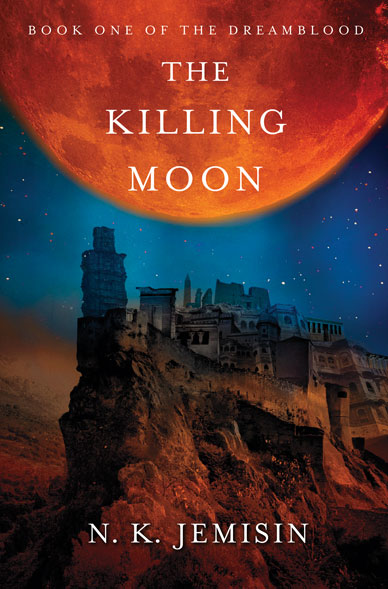
The Killing Moon | by: N.K. Jemisin

Ehiru is a Gatherer, collecting the dreamblood of souls for the good of his people, the people of Gujaareh. His deep devotion to the goddess Hananja has guided him in this job; he and the rest of Gujaareh's citizens live to keep peace in her name. But now, Ehiru's whole world is turned upside down. A Gathering gone wrong, forewarnings of corruption in their society... But are the warnings true?
 
Alongside a spy from a neighboring city and his apprentice, Nijiri, Ehiru will discover horrifying secrets of his city-state and the strange being that roams it. All the while, debates concerning Gujaareh's use of magic flare. How can something so normal to Ehiru be so wrong in a foreigner's eyes?

The Killing Moon is the first novel of N.K. Jemisin's Dreamblood duology, the second being The Shadowed Sun (which also has a beautiful cover). I discovered this novel on Goodreads some months ago, and of course, the drop dead gorgeous cover attracted me to it, leading me to a most peculiar fantasy-oriented summary. Ever since then, I have needed to read this book.

Now that I've finally read it, I can definitely say that it's a very unique piece of fiction. I don't just mean that in terms of plot and magical elements, but I've simply never read a book set in a mock-Egyptian society. It was refreshing to be in such a different world, and Jemisin did a wonderful job crafting it. At the beginning of each chapter, a law of Gujaareh or a piece of wisdom is written before the scene begins, which helped us get to know the world she created even better. Plus, her writing style is just lovely; she definitely has a lot of skill in that department.
 
The characters really stood out as well, especially Ehiru and Nijiri. Both meant well and were guided by love for their goddess in addition to love for each other. But I must admit, their relationship confused me. They have a father/son relationship, yet they were also in love in a romantic way (mainly Nijiri). The idea of both relationships taking place at once made sense for their scenario, but it kind of freaked me out. I just can't imagine being in love with someone and then comparing them to a parent. But like I said, it does make sense for their particular scenario, whether anyone likes it or not.
 
Throughout the novel, there's a huge debate concerning the ways Gatherers use magic, and it parallels to debates on mercy-killing. Anyone reading this book won't be frustrated with this, because the author doesn't really force anyone to pick sides. We're dealing with prominent characters with differing opinions on the matter, and after a while, the problems with Gujaareh become bigger than this debate... Reapers are scary (though very interesting to read about).
 
Oftentimes when I was reading The Killing Moon, I kind of wanted more. There were just a few things that felt a little bit two-dimensional that primarily had to do with magic and dreamblood. I guess I just had a hard time picturing dreamblood, so I wanted to hear more about it on a physical, scientific level. That was probably my biggest complaint as I read. Anything else that seemed to fall flat was inflated in the end - the end of this book is definitely the best part. So much is explained that I didn't see coming! But the ending turned out to have emotional appeal as well. It made my heart sink a bit.

But this book has some interesting features after the story that I'd like to mention: A helpful glossary to guide us while reading (so we understand words like "dreamseed" and "jungissa") and a fun author interview. The author interview was particularly awesome because N.K. Jemisin got to interview herself, and she has a great sense of humor! A unique addition to a unique novel.

So overall, I'd say The Killing Moon has a lot to offer. I liked this book - it didn't strike me as 'Omg, this is mah new favorite!' or anything like that, it just has an excellent quality to it and I've never read anything like this before. N.K. Jemisin accomplished a lot with it, and anyone looking for a different kind of fictional world will find this refreshing.

Thursday, January 9, 2014

Cloud Atlas | by: David Mitchell

David Mitchell's ever-famous Cloud Atlas managed to never cross paths with me for the majority of its existence, for I was way too young to grasp the themes presented in this complex novel when it first came out. But since its cool-looking film adaptation was released a little over a year ago with celebrities such as Tom Hanks and Halle Berry playing lead roles, I inevitably heard about it, read the story's summary, and thought it sounded wonderful. Still, I loved it way more than I anticipated.
 
When one hears that Cloud Atlas is complex, it is because it includes six different stories occurring in different time periods. Reincarnation ties it all together, you just have to pick up the signs. We start in the past and head toward the future, but then we begin to descend into the past. From a man at sea in 1800s to a horrific dystopian future and everything in between, Cloud Atlas' stories are all extremely different. A new time period, a new set of characters, a new writing style, and a new genre comes with each section - but they're tied together somehow.
 
I'll be honest, at first I wasn't the craziest about this book. The first section about Adam Ewing in the 1800s didn't really click with me, personally. But, I had a feeling that this book may require patience, which I had. The second section began to pick up a bit, even though I wasn't exactly Robert's number one fan, but stuff started getting intense with Luisa's story. That's when the action started and when the common theme really took precedence.

Then, we get to step into the present in the life of Timothy, who runs a publishing company gaining success, but Timothy ends up on the run. His story is probably my least-favorite of them overall. It just felt... Morbid.

But finally, we're transported into the future to meet Sonmi-451. Her story is my favorite of them all; this is when I really began to love this book - and not just for this story, but for the common themes throughout the novel. Unlike the previous stories, this one is dystopian, and I tend to be a sucker for dystopian stories. But part of what's special about Sonmi's story is how innocent she was when she began, before her friend lost her mind for a way out of the restaurant they were basically slaves to, even just after she left to see the unknown outside world. There's a part in which she travels from one part of Korea to another, and she said she thought she'd seen most of the world. That killed me.

Sonmi didn't go off to fight in any epic battles or win any Hunger Games, but she wrote something that would make her one of the most important historical figures later on. She started out not knowing much of anything about the world she lived in, but she knew what she was getting into. The dystopian scenario she lived in was horrific. She knew what would happen, but after seeing so many horrible things in this futuristic hell, she knew what was important was so much bigger.

So much bigger, in fact, that her memory would remain for such a long time. In post-apocalyptic Hawii, civilization has taken a huge downfall. Technology is gone. There is no security. But Sonmi-451 is so important to Zachry, who has not had an ideal life in any sense. Tragedy is everywhere on Big I, so I found this story very depressing - even disturbing at some parts. However, it's very meaningful, and I think it's my second-favorite tale. But when Meronym comes from afar, Zachry learns about some of the history and present conditions of civilization outside of their little island. He also makes some of his own discoveries about reincarnation.

But what ties all of these stories together? Well, for one thing, people. Like I said, reincarnation is prominent in this book. However, in each of these stories, the characters have similar problems with suppression, being confined to one place, not knowing the whole truth, questions of what is moral. But they all also find that there are some people in the world that will try to help. It's like Meronym tells Zachry, the whole world isn't all bad; the villains and tyrants of the world just have the ability to scream a little louder than everyone else. They somehow end up with obvious power, but our characters are also certainly not powerless. One person can put a decent-sized dent in history that will affect generations to come.

This was a brilliant idea for a novel; it's no wonder it's gotten so much praise. Deep themes, a unique set of characters, and great writing - what more could I ask for? I highly recommend David Mitchell's Cloud Atlas to anyone that hasn't tried it yet. Just be patient in the beginning and pay attention to birthmarks, because this book is definitely worth paying attention to.

Thursday, January 12, 2012

Miss Peregrine's Home for Peculiar Children | by: Ransom Riggs

Jacob's grandfather has always showed him the most peculiar old photographs and told him strange stories to match, but how could he ever believe fairy tales of such sorts? After all, his grandfather's state of mind was questionable due to experiences during World War II that surely traumatized him. In his need to find the truth about these odd photographs, Jacob takes a trip to an island outside Great Britain, where his grandfather once lived in an old orphanage there. Meanwhile, he finds that there is more to the orphanage than one could ever imagine, that what may seem absolutely crazy is reality. For this is no typical orphanage; it's Miss Peregrine's Home for Peculiar Children, and while exploring it's remains Jacob finds himself in an otherworldly adventure.

Miss Peregrine's Home for Peculiar Children is Ransom Riggs' debut novel, and I must say, it was put together very uniquely. I'm not just talking about the story itself, but the idea of putting in old photographs (some slightly manipulated to fit the story's purposes) throughout the book. As a book lover and a photography lover, I was quite intrigued.

This book is naturally spooky with its rainy, gloomy setting (not to mention the ties to World War II). It probably would have stayed eerie even without the monsters and children with strange abilities. However, the characters themselves didn't really freak me out, I enjoyed them. All of them are capable of wondrous things, each with an ability unique to them. Some are unusually strong, some levitate. I wouldn't want to anger any of them, but they all seemed to be generally nice people. Jacob was a pretty good main character. Even though he was an unhappy rich boy, he came off as very down-to-earth and made me laugh aloud when reading, particularly towards the beginning of the story.

On a darker note, Ransom Riggs wrote about the grieving process that Jacob went through quite impressively. I was so surprised to see how this aspect of death ended up being so reasonably written. From previous reading experiences, I have found that most authors don't do well with describing grieving characters. It seems that they only show a couple of emotional spurts that are written ineffectively, almost like they're not real, giving me little to no effect. Ransom Riggs was an exception because he's a great writer and did his job well.

The only major complaint I've been hearing about this novel is its ending. People claim it doesn't have one. Due to prior reading expereinces I have found that when people say things like that, they aren't looking through the right spectacles. In this case, there isn't a conclusion to the obvious large problem now at hand; however, Jacob comes to a conclusion of the dilemma he'd been facing for a while and finally figures out what he wants to do with his life and where he truly feels he belongs. That, my friends, is an ending. A good ending.

Miss Peregrine's Home for Peculiar Children is different. It's a fun adventure filled with mystery that any age group can enjoy.

4.5/5 Stars


Riggs, Ransom. Miss Peregrine's Home for Peculiar Children
Philadelphia, Pennsylvania: Quirk Books
2011

Thursday, August 12, 2010

White Cat | by: Holly Black

In the world created by Holly Black, there are curse workers - people who have the magic in their touch to affect others. They can change their memories, luck, emotions, and even more if you're touched by one. Because of their amazing advantages over people, a lot of them become con artists. Cassel comes from an entire family of con artists, of curse workers, yet he has no magic. It seems the only thing he has that the rest of his family doesn't is the horrid guilt of killing his best friend years ago.

Since his family are curse workers, they have power over him, but family is everything to all of them, so they never con another. But Cassel is starting to question this, as secrets unfold. And it all started with the appearance of a white cat.

I was hesitant to pick up White Cat, but I'm more than glad I did. This story is so intricate, it's difficult for me to explain. It's one of the most unique books I've ever read in my life. I don't really know where to begin.

With a one of a kind storyline, you get a main charecter that lives up to the hype. (Thank you, Holly Black!) Cassel is a very likeable charecter. His narrations are very interesting to read. He's sarcastic at times, down to earth, yet sometimes he can seem deep, and when his heart aches, you ache with him. I had no difficulty to take him seriously. An complex charecter for a complex story.

I've never read any of her books before, but from White Cat, I can tell Holly Black is a great writer. Sometimes, I'd have to go back and reread sentences, only to find that she's written the statement too well. Her writing will leave an effect on you, as if she's a worker herself, cursing us with her wonderful choice of words. She also has some serious creativity. Curse workers? How did she come up with this concept? There were so many twists and turns in this mystery-filled book, I don't know how she could have kept track of everything. I would have lost my mind trying to write this novel! When you expect things to flow like a typical book, don't. White Cat is far from typical. I was surprised and filled with complete shock over and over again.

White Cat is mysterious, suspensful, and even a bit romantic. I was completely into this book, and I'll never forget this one. In some way, each element in this story falls into the perfect places, but you'll never see what's coming.

The ending will freak you out a bit, and you'll want the next book to appear on your bookshelf. I know I can't wait.

4.5/5 stars

Saturday, June 5, 2010

Harry Potter and the Prisoner of Azkaban by: J.K Rowling


Harry Potter, the infamous wizard, returns for his third year at Hogwarts in a bit of chaos. First, there was an incident with of his aunts the previous summer that may have caused him to get into big trouble. Then, more significantly, he learns of a criminal that escaped from Azkaban prison right before he returns to Hogwarts. No one has ever escaped from Azkaban before until now. And worst of all, this murderous prisoner, named Sirius Black, escaped to come for Harry. Surely, this prisoner won't be able to come into the castle with all the precautions being taken. dementors, which are grim and horrific creatures, surround the castle in hopes of finding Sirius Black. But what if the others are right? What if Harry goes looking for Black? But Harry doesn't understand why he would have a reason to...

But, things aren't always as they appear to be. In Harry Potter and the Prisoner of Azkaban, secrets of the past are unleashed, and these secrets could change the future, and consequences could leave room for changing the past.

This third installment of the Harry Potter series is filled with magic and mystery. Everything is unexpected, so I was always eager to keep reading. Sometimes, I couldn't stop. J.K Rowling is a phenominal writer, as we already know, and it is evident here. Harry Potter and the Prisoner of Azkaban has an amazing amount of entertainment within its pages, and with the entertainment comes meaning. That can not be said for most books, especially when they are in the middle of a series. Harry Potter in the Prisoner of Azkaban is truly epic.

5/5 stars